
Table of Contents
ToggleKaal Sarp Dosh Puja in Ujjain: An Introduction.
If you keep running into roadblocks, delays, or just feel like life keeps throwing curveballs your way, you’re not alone—and you’re not helpless either. In Vedic astrology, one of the most talked-about reasons for this kind of bad luck is Kaal Sarp Dosh. It’s a planetary issue that, people say, can mess with your career, marriage, money, health, and even your peace of mind. The good news? There’s a remedy, and Ujjain is the place for it.
Why Ujjain?
This city isn’t just old—it’s one of India’s oldest spiritual powerhouses, home to Lord Mahakal. Every year, thousands head to Ujjain to perform the Kaal Sarp Dosh Puja, hoping to shake off stubborn problems that just won’t quit. When done right, with proper rituals led by experienced pandits, this puja is said to neutralize negative planetary vibes and help life get back on track.
Curious about what all this means? Let’s break it down..
What Is Kaal Sarp Dosh?

In simple terms, Kaal Sarp Dosh happens in your birth chart when all seven main planets—Sun, Moon, Mars, Mercury, Jupiter, Venus, and Saturn—sit squeezed between Rahu and Ketu. Now, Rahu and Ketu aren’t even real planets; they’re shadowy points that represent things like karma, illusion, fear, and sudden change.
Rahu stands for ambition, confusion, obsession, and that constant craving for more. Ketu, on the other hand, is all about letting go, spirituality, isolation, and stuff from past lives. When these two dominate your horoscope, they block the good stuff from other planets and leave you stuck in a loop of problems.
Different Types of Kaal Sarp Dosh
Not all Kaal Sarp Dosh is the same. There are actually 12 types, each named differently depending on which houses Rahu and Ketu sit in. Some of the big ones:
Anant, Kulik, Vasuki, Shankhpal, Padma, Mahapadma, Takshak, Karkotak, Shankhachood, Ghatak, Vishdhar, and Sheshnag Kaal Sarp Dosh..
Each one hits different areas of life, and the intensity can change—but they all bring trouble if left unchecked.
How Do You Know If You Have Kaal Sarp Dosh?
People dealing with it tend to have the same sorts of issues—no matter who they are.
Career
Jobs don’t stick. Promotions slip away. Office politics gets ugly. Sometimes, jobs vanish overnight.
Marriage & Relationships
Marriages get delayed for no obvious reason. Engagements break off. Married life feels tense or empty.
Money Problems
You earn, but savings just don’t add up. Expenses pop up out of nowhere. Businesses suffer. Debt piles up.
Mental & Emotional Struggles
Anxiety creeps in for no reason. There’s a constant fear of what’s next. Confidence drops. Sleep gets patchy.
Why Go to Ujjain for Kaal Sarp Dosh Puja?
Ujjain isn’t just any holy city—it’s astrologically special. In ancient times, this was the place astrologers used to track planetary movements. It’s one of the legendary Sapta Puris (seven sacred cities), tied directly to the concept of time itself—‘Kaal.’
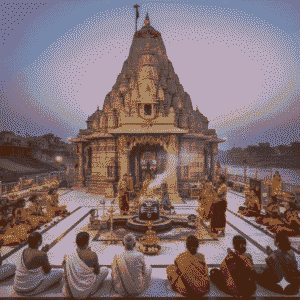
At the heart of Ujjain sits Mahakaleshwar Jyotirlinga, one of the twelve big Shiva shrines. It’s unique because it faces south (Dakshinamukhi), and Lord Mahakal is seen as the master of time and karma. Since Kaal Sarp Dosh connects to both time and karma, doing the puja here, in the presence of Mahakal, is believed to pack a bigger punch.
The Shipra River’s Role

There’s also the Shipra River, which runs through Ujjain. It’s not just a pretty sight—it’s a big part of the ritual. Most people start the puja with a dip or symbolic wash in the river. This is supposed to clear out negative energy and lighten the load of past karma, getting you ready for the main event.
How the Kaal Sarp Dosh Puja Happens in Ujjain
This isn’t a casual affair. The ritual follows strict Vedic rules and experienced pandits guide every step.
Step 1: Sankalp
You state your name, gotra, birth details, and why you’re here. This links the ritual to your personal karma.
Step 2: Ganesh Puja
First, you pray to Lord Ganesha to remove any obstacles and make sure everything goes smoothly.
Step 3: Navagraha Puja
All nine planets get worshipped, but Rahu and Ketu get special attention to help balance out their effects.
Step 4: Rahu–Ketu Mantra Jaap
Powerful mantras are chanted, aiming to calm Rahu and Ketu and soften their grip.
Step 5: Naag–Naagin Pratima Puja
You worship snake idols—usually silver or copper—as a way of owning up to past mistakes and asking for karmic relief.
Step 6: Havan
A sacred fire ritual, where offerings go into the flames, meant to burn away old negative karma.
Step 7: Naag Pratima Visarjan
Finally, you immerse the snake idols at a holy spot, letting go of the baggage you’ve been carrying.
That’s the journey. People who go through with it often talk about feeling lighter, more balanced, and ready to move on from whatever’s been holding them back.